PhD students & postdocs
Early Career Meeting
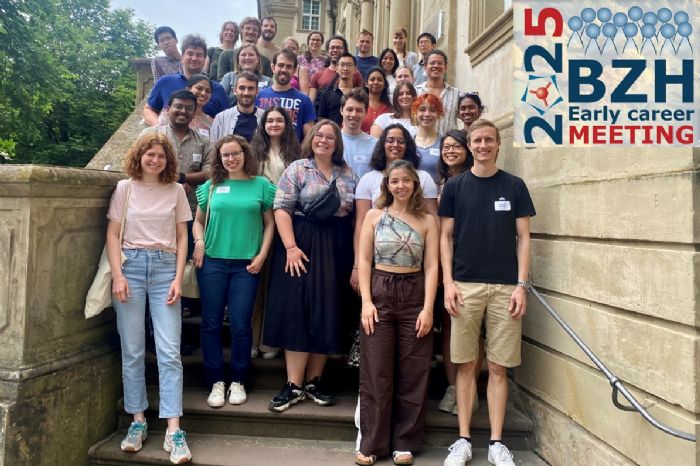
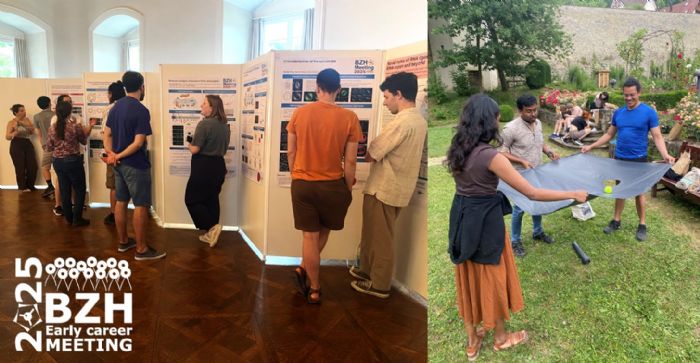
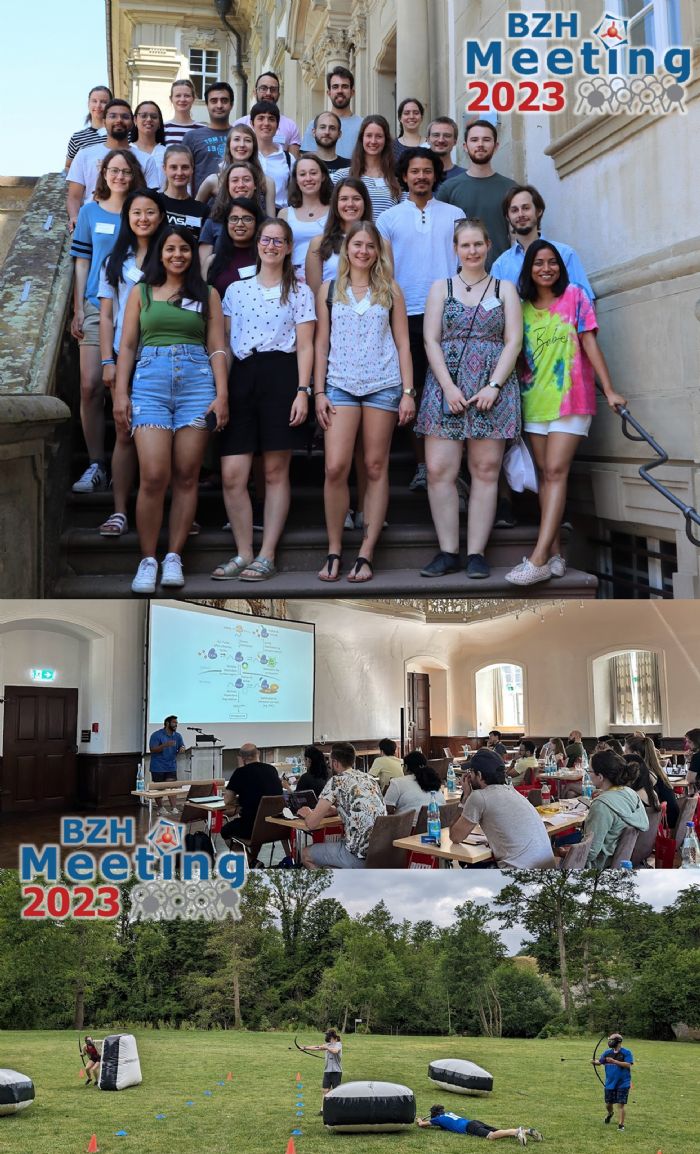
The BZH Early Career Meeting is an annual retreat for PhD students and postdoctoral fellows, held over an extended weekend at Kloster Schöntal (Baden-Württemberg). The scientific program, organized entirely by the PhD board, includes presentations, two poster sessions, and roundtable discussions.In formal presentations, one selected PhD student from each BZH group briefly introduces the group’s main research topic and presents his/her specific project in front of an audience of about fifty colleagues. Complementary poster sessions provide ample opportunities for each student to present and discuss individual projects in detail in an informal setting. Highly appreciated are the round table discussions where five to six people from different groups come together presenting their projects in a concise manner without the use of any technical support (no slides, etc.). This encourages direct scientific exchange, instant feedback from the other participants and sharpens the presentation skills by focusing on the main scientific issues.
Importantly, three national/international guest speakers are invited by the students to present keynote lectures. These guests are welcome and encouraged to participate in the rest of the scientific and social activities during the meeting and to share their experience with the young scientists.
The BZH Early Career Meeting provides a platform not limited to scientific exchange, it also fosters personal exchange, the integration of new lab members, and the building of networks by including social events such as canoeing, hiking or board gaming. Again, the students choose the social activities.
During formal presentations, a selected PhD student from each BZH group introduces the group’s main research topic and presents their specific project to an audience of about fifty colleagues. Poster sessions allow for detailed discussions in an informal setting. The roundtable discussions, where five to six participants present their projects without technical support, encourage direct scientific exchange and enhance presentation skills.
Three national or international guest speakers are invited by the students to deliver keynote lectures and participate in the scientific and social activities throughout the meeting.
The BZH Early Career Meeting fosters both scientific and personal exchange, integrating new lab members and building networks through social events like canoeing, hiking, and board gaming, with activities chosen by the Early Career Researchers.
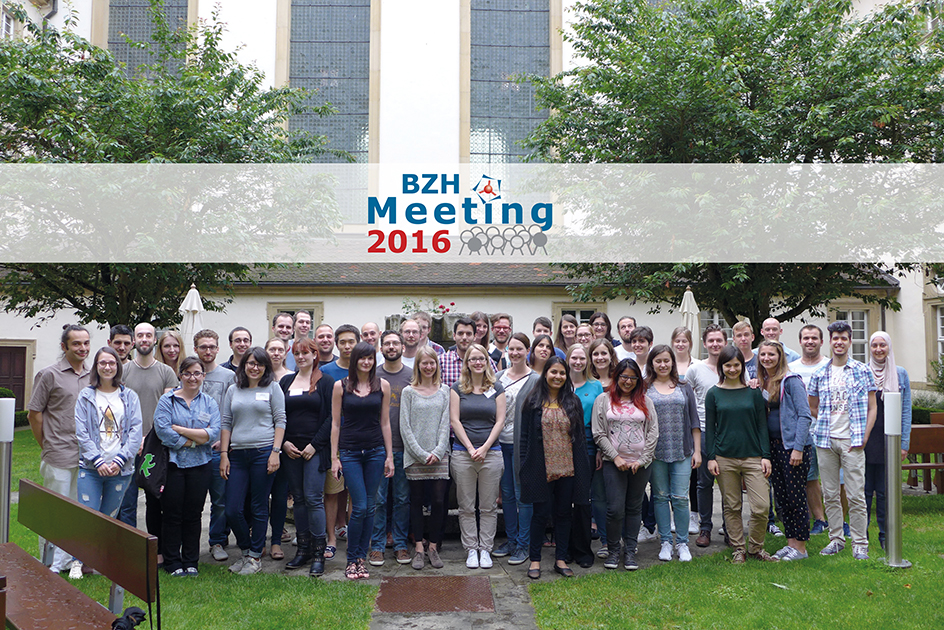
The first BZH meeting, now the BZH Early Career Meeting, took place in 2016, with over 50 participants, 40 poster presentations, and 10 talks, making it a successful gathering. Subsequent meetings have continued to provide unique opportunities for training and preparation for the next steps in their careers.
PhD Student Board
E-mail: PhDBoard@bzh.uni-heidelberg.deWeb: www.bzh.uni-heidelberg.de/PhDBoard
BZH Meeting 2025
Kloster Schöntal, June 26.-28.Guest Speakers
|
Shin Numao
|
Novartis, Switzerland | Unlocking Opportunities: Navigating the Path from PhD to Industry Success |
| Arne Möller | Universität Osnabrück | Cryo EM on the Move Sensing and Signalling |
| Emma Fenech | Universität Köln | Unravelling endoplasmic reticulum complexity with novel systematic approaches mitochondria |
BZH Meeting 2024
Kloster Schöntal, June 26.-28.Guest Speakers
|
Dr. Federica Fiorentino
|
Roche, Switzerland |
Unlocking Opportunities: Navigating the Path from PhD to Industry Success |
| Prof. James Hurley | University of California, Berkely, USA |
Molecular Gymnastics of Lysosome Nutrient Sensing and Signalling |
| Prof. Robert Ernst |
Universität des Saarlandes |
Protein homeostasis at the crossroads to mitochondria |
BZH Meeting 2023
Kloster Schöntal, June 22.-24.Guest Speakers
|
Dr. Tom Rapoport
|
Harvard Medical School, USA |
My long happy life in science (and what you might learn from it) |
| Dr. Stephan Kirchmaier | Promega, Germany |
From cloning genes to crafting copy: A shift from academia to product marketing |
| Dr. Agnieszka Chacinska |
IMol Polish Academy of Sciences, Poland |
Protein homeostasis at the crossroads to mitochondria |
BZH Meeting 2022
Kloster Schöntal, July 21.-23Guest Speakers
|
Dr. Elena Porcellato
|
EuroAPI, Paris, France |
It's all about chemistry: my journey from the BZH to industry |
| Dr. Andrea Thorn | Hamburg University, Germany |
Coronavirus structural Task Force |
| Dr. Dimitrios Papagiannidis |
EMBL, Heidelberg, Germany |
Unraveling the receptor-ligand landscape of human gut microbial species |
BZH Meeting 2021
Online-Meeting, July 22.Guest Speakers
|
Georg Borner
|
Max-Planck-Institut für Biochemie |
Martinsried - Spatial Proteomics: A Swiss Army Knife for Cell Biologists |
Susan Lea |
Center for Structural Biology, National Cancer Institute, USA |
Structural stories from bacterial motility. |

BZH Meeting 2020 (cancelled)
Online-Meeting, June 25-27.
BZH Meeting 2019
Kloster Schöntal, July 25.-27.Guest Speakers
|
Julia von Blume
|
Yale University, USA |
Mechanism of Ca2+ dependent protein secretion |
Petr Chlanda |
University of Heidelberg Medical School |
Structural analyses of influenza and Ebola virus entry by cryo-electron tomography. |
Harvey McMahon |
MRC, Cambridge, UK |
The structure-based targeting of alpha-synuclein to mitochondria promotes cellular health |
BZH Meeting 2018
Kloster Schöntal, July 15.-17.Guest Speakers
|
Hiro Saito
|
Kyoto University, Japan |
Synthetic RNA technologies to control mammalian cell fate |
| Kevin Moreau |
MRC,Cambridge, UK |
Mechanisms of unconventional secretion - with a hint of conventional secretion. |
| Blanche Schwappach |
Göttingen University, Germany |
Functional analysis of ArfGAP proteins in their unique molecular niches on COPI vesicles |
BZH Meeting 2017
Kloster Schöntal, June 25.-26.Guest Speakers
| Patrick Cramer | Max Planck Institute for Biophysical Chemistry, Göttingen | How genes are switched on |
| Wolfgang Baumeister | Max Planck Institute of Biochemistry, Martinsried | The molecular machinery of protein degradation - structural studies ex situ and in situ |
| Terry Roemer | Merck Research Laboratories, Kenilworth New Jersey, USA |
Chemical Biology Approaches to Novel Antibiotic Discovery |
BZH Meeting 2016
Guest Speakers
| Gunter Meister | Universität Regensburg | Crosstalk between tRNAs and miRNAs mediated by the Lupus autoantigen La |
| Nicolas Leulliot | Paris Descartes University | Structural exploration of ribosome biogenesis |
| Christine Mayr | Memorial Sloan Kettering Cancer Center, New York |
Alternative 3'UTRs mediate protein-protein interactions and regulate protein localization and functions |
Impressions